
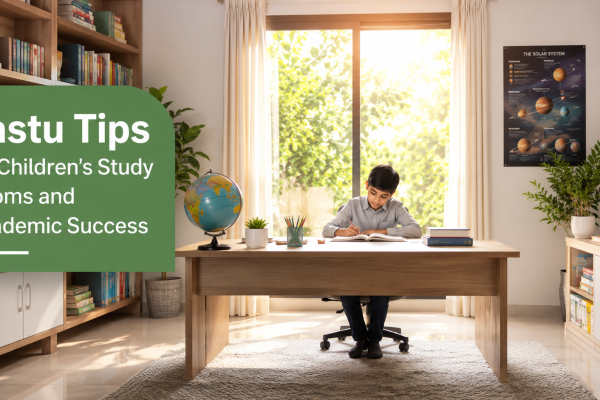
Every parent wants their child to sit down to study without drama, focus for longer, and walk into exams with confidence. A lot of this depends not just on willpower, but on the environment the child is placed in every single day. That is exactly where Vastu for children’s study rooms becomes practical: it gives you a simple framework to design a space that supports learning instead of fighting against it.
In this guide, you’ll learn how to use Vastu to plan your child’s study direction, table placement, colours, lighting, storage, and even what to avoid, so the room naturally encourages discipline, calmness and better academic performance.
As parents, everyone wants their children to study with focus, enjoy learning, and perform well in exams. Vastu Shastra, the ancient Indian science of space and energy, offers simple, practical guidelines to design a study room that supports concentration, confidence, and academic success. You don’t need a complete renovation; often, small changes in direction, placement, and décor can shift the energy of a child’s study space in a powerful way.
The first and most important factor is the direction in which the child studies. Facing east or north while studying is considered ideal, as these directions are associated with growth, knowledge, and positive mental energy. When the study table is placed so that the child faces east or north, it is believed to improve clarity of thought, memory retention, and the ability to grasp new concepts more easily. Try to avoid placing the study table so the child faces a blank wall in the south or has a door directly behind them, as this can create subtle restlessness or a lack of security.
East – linked with new beginnings and clear thinking
North – associated with logic, career and growth
North-East – considered highly auspicious for learning
You don’t have to rebuild the house. In most flats, simply rotating the study table so the child faces east or north while studying is a big step.
What to avoid
Facing south for long study hours
Sitting with a door directly behind the child
Facing a toilet wall while studying
If you can’t change the room, change the table direction. Even a 90-degree rotation can improve comfort and focus.
The placement and design of the study table also matter. A sturdy rectangular or square table is preferred over irregular shapes, as it symbolizes stability and balance. Ensure there is a solid wall behind the chair to give the child a sense of support and confidence, and leave some open space in front of the table instead of pushing it tightly into a corner. This open space is believed to represent new opportunities and ideas. Keep the table clutter-free—only the necessary books and stationery should be on it, while extra materials can be stored neatly in shelves or drawers.

Practical Vastu rules for the study table
Light directly affects the brain’s alertness. For a Vastu-aligned study space:
A dim, poorly lit room almost guarantees daydreaming and low energy. Good light helps the child feel awake before they even open a book.
Even small changes here often show up as fewer headaches and less irritation during study time.
Use these as wall colours or as the dominant colour in curtains, storage units and soft furnishings.
The aim is to keep the nervous system relaxed so the child can handle academic pressure more easily.
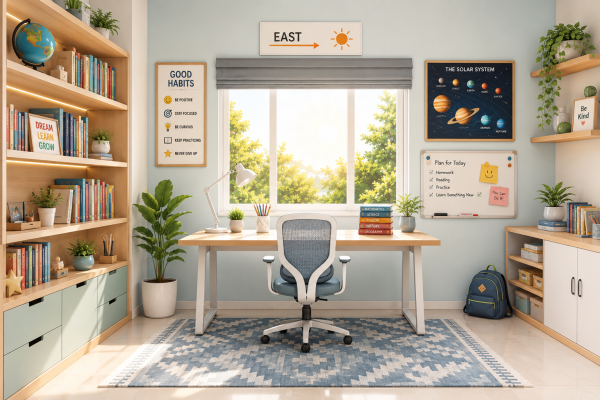
Storage and organization are another key Vastu focus. Bookshelves should be neat and preferably placed towards the south or west walls, leaving the north and east relatively light and open. Broken stationery, torn books, unsharpened pencils, and piles of old notebooks send a message of “incomplete” energy, which can reflect in low motivation or confusion. Make it a weekly ritual with your child to declutter the study area, throw away non-working pens, and arrange books according to subjects. This habit not only supports good Vastu but also teaches discipline and ownership.
Try to keep these out of the study zone or at least out of direct sight:
If a computer is necessary:
If possible, avoid:
If you can’t fully fix it (like in rented flats), compensate with better lighting, decluttering, and strong routines.
Small changes in the room can quietly shape how a child feels about studying. You can hang a world globe, a simple motivational quote, or a picture of the rising sun, nature, or birds on the wall in front of the study table to keep the mood hopeful and forward-looking. A small indoor plant, if you’re able to care for it, adds a bit of freshness and life to the space. The idea is to build a corner where the child feels relaxed, supported, and naturally motivated to learn, rather than pushed or stressed.
Vastu for children’s study rooms is not about superstition; it is about intentionally designing a peaceful, organized, and energizing environment that aligns with both tradition and common sense. Even if you cannot follow every recommendation perfectly, start with what is practical – direction of the table, decluttering, better light, and soothing colours. Over time, you may notice a shift in your child’s focus and attitude towards learning.
Ready to align your space for health, harmony, and growth?
© 2025-2026 Vaastublessings • All Rights Reserved. Designed by Esuccess Academy