
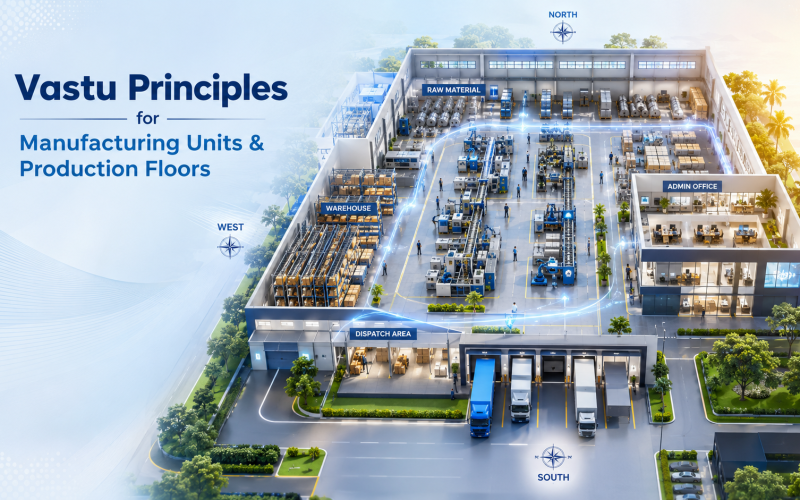
Running a manufacturing unit isn’t only about investing in machinery or hiring skilled workers. Every factory owner wants smooth production, better efficiency, fewer breakdowns, timely deliveries, and consistent business growth.
While operational planning plays a major role, many industrialists also consider Vastu Shastra when designing or renovating their factories.
A well-planned manufacturing unit based on Vastu principles is believed to support a balanced working environment, improve workflow, reduce unnecessary disruptions, and create a more organized production system.
Whether you’re setting up a new factory or planning to redesign an existing production floor, understanding the right Vastu guidelines can help you make informed decisions.
In this guide, we’ll cover practical Vastu principles for manufacturing units, machinery placement, raw material storage, office locations, and production floor planning.
Vastu Shastra is based on the concept that every direction is associated with one of the five natural elements – Earth, Water, Fire, Air, and Space. According to Vastu philosophy, the appropriate placement of different activities within these directional zones helps maintain balance within a structure.
In industrial environments, this concept is applied by assigning different departments according to their functional characteristics. For example, heavy machinery is generally recommended in stable directions, while water-related utilities are placed in water-associated zones.
The objective is to create an organized working environment where movement, production processes, storage, and administration can function efficiently.
Manufacturing units involve continuous movement of raw materials, finished products, machinery, employees, and vehicles. A poorly planned layout can result in unnecessary movement, operational delays, congestion, and inefficient utilization of available space.
Vastu planning attempts to create a structured factory layout by defining suitable locations for different operational areas. It emphasizes logical workflow, proper zoning, and systematic placement of departments.
Many industries consider Vastu during the planning stage of:
The planning of a manufacturing unit generally begins with selecting an appropriate plot, designing the building layout, and allocating different departments according to Vastu guidelines.
The major principles include:
Each of these principles contributes to a structured industrial environment.
The entrance of a manufacturing unit is regarded as one of the most significant components of industrial Vastu.
According to traditional Vastu principles, the entrance serves as the primary access point for employees, visitors, goods, and business activities. Therefore, its location is considered important while planning an industrial building.
The North and East directions are generally regarded as favorable for factory entrances because they are traditionally associated with growth, movement, and positive energy.
The entrance should remain clean, spacious, and free from obstructions to facilitate smooth movement.
One of the primary objectives of industrial planning is to establish an efficient production process.
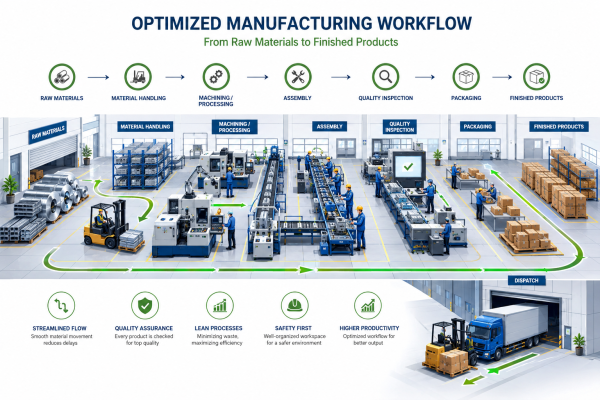
From a Vastu perspective, the internal arrangement of departments should follow a logical sequence that minimizes unnecessary movement of materials and workers.
Raw Material Storage → Processing → Manufacturing → Quality Inspection → Packaging → Finished Goods Storage → Dispatch
This sequential arrangement supports systematic operations and reduces handling time.
Heavy industrial machinery forms the core of manufacturing operations.
According to Vastu, machinery that generates vibration, weight, and continuous mechanical movement is generally recommended to be installed in the South, South-West, or West portions of the factory.
These directions are traditionally associated with stability and strength.
Examples include:
Placing heavy machinery in the North-East is generally discouraged within traditional Vastu principles.
Raw materials represent future production and therefore require careful storage planning.
Vastu recommends locating raw material storage in the South-West portion of the factory because this direction is believed to provide stability for heavy inventory.
Materials commonly stored include:
Proper organization of raw materials also improves inventory management and production planning.
After production and packaging, finished products move to storage before dispatch.
According to Vastu, the North-West direction is generally considered suitable for finished goods storage and dispatch activities because it is traditionally associated with movement and transportation.
This location supports easy loading and timely shipment of products.
Manufacturing industries contain several electrical and heat-generating systems.
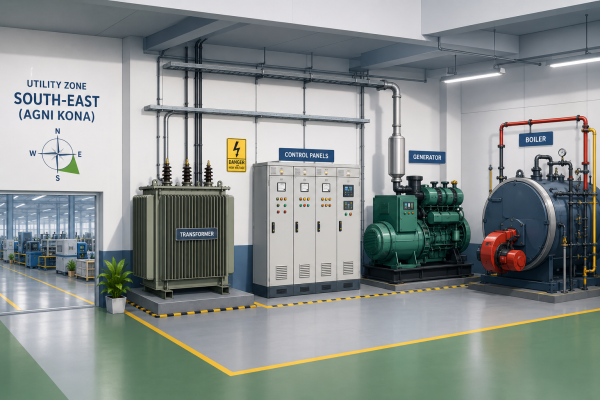
These include:
The South-East direction is associated with the Fire element in Vastu and is therefore considered appropriate for these installations.
Proper planning of electrical utilities also improves maintenance accessibility and operational safety.
The administrative office manages planning, finance, purchasing, human resources, and decision-making.
According to Vastu principles, administrative offices are generally recommended in the North, East, or North-East portions of the manufacturing unit.
The factory owner’s cabin is often planned in the South-West while the seating position faces North or East.
Conference rooms, reception areas, and customer meeting rooms are commonly located near the entrance for convenience.
Water plays an important role in industrial operations.
Factories require water for manufacturing processes, employee use, cleaning, and fire safety systems.
According to Vastu, water-related structures such as:
are generally recommended in the North-East direction.
Proper placement of water resources is considered important in traditional Vastu planning.
The shape of the industrial plot also receives importance in Vastu Shastra.
Square and rectangular plots are generally preferred because they provide balanced planning opportunities and allow efficient space utilization.
Irregularly shaped plots may create planning challenges and often require professional assessment before construction.
Although Vastu primarily focuses on directional planning, it also emphasizes maintaining a clean and healthy environment.
Industrial buildings should have:
These practical measures improve employee comfort and operational efficiency while supporting general industrial management practices.
Several planning issues are commonly observed in manufacturing units.
These include:
Such issues may reduce operational efficiency and complicate day-to-day manufacturing activities.
Many factory owners consider Vastu as a supporting framework for industrial planning.
Potential benefits often associated with proper Vastu planning include:
It is important to note that these outcomes also depend on engineering design, production management, workforce efficiency, technology, and compliance with industrial safety standards.
Vastu Shastra provides a traditional framework for planning manufacturing units and production floors by assigning different industrial activities to specific directional zones. Its principles emphasize systematic layout planning, proper zoning, efficient workflow, and organized utilization of available space.
While Vastu is widely followed by many industrialists during factory construction and renovation, it should be considered alongside modern industrial engineering, safety regulations, operational requirements, and statutory compliance. A well-designed manufacturing facility combines practical planning with efficient resource management to create a productive and organized working environment.
Businesses planning a new factory or upgrading an existing production facility may consult an experienced Vastu professional to evaluate the layout and recommend suitable modifications that align with both operational needs and traditional Vastu principles.
Ready to align your space for health, harmony, and growth?
© 2025-2026 Vaastublessings • All Rights Reserved. Designed by Esuccess Academy