
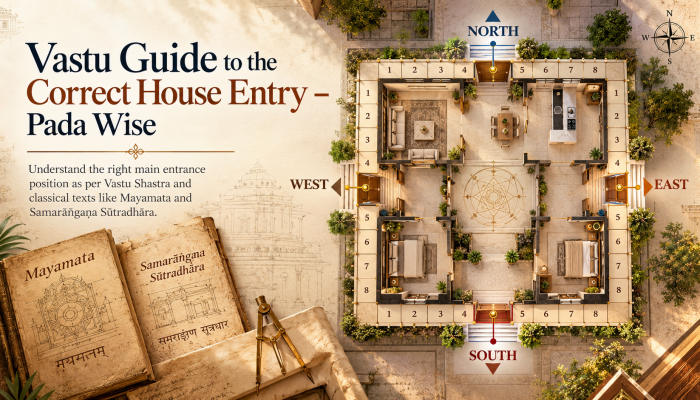
When planning a home according to Vastu, one of the first questions people usually ask is, “Which direction should the main entrance face?”
Direction is certainly important, but traditional Vastu goes a step further. It also considers where exactly the entrance is located on that particular side of the house. This finer division is commonly explained through the concept of Pada, or a specific segment of the building’s perimeter.
That is why two houses may both be described as “east-facing” but still have different entrance positions from a traditional Vastu perspective.
The entrance is not treated simply as a doorway. Traditional architectural principles give considerable attention to its position, proportions, orientation and relationship with the overall house plan. The location of the doorway is therefore considered together with the geometry and planning of the house rather than being judged only by its direction.
The word Pada can be understood as a division or designated section. In entrance analysis, the external boundary of a house is divided into specific sections, and the location of the main doorway is assessed according to the section in which it falls.
A commonly used approach divides the four sides into smaller padas. Each section is associated with a particular name and traditional interpretation.
This is important because simply saying “North-facing entrance is good” does not tell the complete story. The precise position of the door on the northern wall also matters.
The centre line of the entrance is particularly important when determining its pada. Even when the door appears to be approximately in the right area, accurate measurement can place it in a different section.
The eastern side is traditionally associated with sunrise, illumination and the beginning of the day. Mahendra Pada is recognised as an important entrance position on the eastern side.
Traditional architectural references consistently identify Mahendra as a suitable position for the main entrance on an east-facing house.
However, this does not mean that every east-facing entrance automatically receives the same interpretation. The exact location should be measured against the house’s actual dimensions.
For example, if the eastern wall is divided into sections, moving the entrance considerably toward a corner may place it in another pada. Therefore, simply checking the direction with a compass is not enough.
An east-facing home should be assessed through both orientation and precise entrance placement.
South-facing entrances are often discussed in a very simplified way. Traditional Vastu, however, provides a more detailed approach.
One interesting aspect is that classical sources do not always use exactly the same name for every pada. In comparative studies, the south-side entrance is one of the areas where a variation in terminology can be observed. One tradition identifies Gṛhakṣata as the relevant entrance position, while another uses a different name for the corresponding position.
The important point is that the underlying entrance location is not something that should be judged simply by saying “south is bad.”
A south-facing house can therefore be studied through its precise entrance location, plot geometry, dimensions and the particular traditional methodology being followed.
This is also why copying a generic Vastu chart from the internet may lead to confusion. Different traditions sometimes use different names for corresponding positions.
For the western side, Pushpadanta Pada is traditionally recognised as an important entrance position.
Comparative studies of traditional architectural principles identify Pushpadanta as the corresponding western entrance position.
A west-facing entrance should therefore be evaluated according to its exact position along the western wall rather than simply being classified as favourable or unfavourable because the house faces west.
The entrance should be measured from the actual building perimeter. The road direction, neighbouring property or compound wall should not be confused with the orientation of the house itself.
This distinction becomes particularly important in urban homes, where the plot, building and road may not have exactly the same orientation.
On the northern side, Bhallata Pada is traditionally recognised as a significant entrance position.
Comparative references identify Bhallata as the corresponding northern entrance position across the principal traditions considered for this analysis.
North-facing houses are frequently associated with prosperity and opportunities in contemporary Vastu discussions. However, the entrance should still be examined at the pada level.
A north-facing house with a door placed toward a different section of the northern wall is not necessarily equivalent to one where the entrance falls precisely within the recommended pada.
Therefore, the direction provides the starting point, while the pada provides the finer level of analysis.
A basic assessment can follow these steps:
This last step is particularly important.
A house should not be judged entirely from one doorway. Its orientation, proportions, internal arrangement, circulation, open spaces and relationship between different parts of the building form part of a larger architectural picture.
The biggest advantage of pada-wise analysis is that it moves the discussion beyond broad statements such as “East is good” or “South is bad.”
A door can be located on the same directional wall but occupy a completely different position along that wall.
Traditional architectural planning recognises this distinction. Entrance placement is therefore more precise when the actual location of the doorway is measured rather than judged visually.
It is also worth remembering that modern online Vastu charts do not always use identical terminology. Different traditional sources, translations and schools may present variations in names or classifications.
This does not necessarily mean that the entire system is contradictory. In many cases, the broader recommended location remains similar while the terminology differs. A comparative study of traditional sources, for example, finds substantial agreement on the principal entrance locations despite some variation in the names assigned to the padas.
The main entrance is one of the most carefully considered elements of traditional Vastu architecture. Finding the appropriate entrance is not simply a matter of choosing North, South, East or West.
Direction tells you the side. Pada tells you the specific position.
A proper entrance assessment should therefore begin with accurate orientation and measurement. Once the relevant pada has been identified, its traditional interpretation can be studied in the context of the complete house.
It is equally important to recognise that classical Vastu literature contains variations in terminology and certain classifications. Rather than forcing every tradition into one modern chart, it is more accurate to identify the methodology being followed and apply it consistently.
For homeowners, the practical approach is simple:
Measure first. Identify the direction. Determine the pada. Then interpret the entrance in the context of the entire house.
That makes a pada-wise approach more structured and meaningful than relying on generic direction-based Vastu rules.
Ready to align your space for health, harmony, and growth?
© 2025-2026 Vaastublessings • All Rights Reserved. Designed by Esuccess Academy