
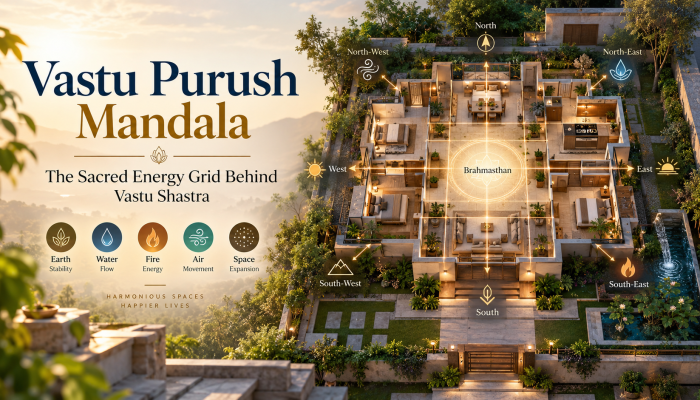
When people hear the term Vastu Shastra, they often think about directions, entrances, kitchens, bedrooms, or the placement of a pooja room. But behind many of these recommendations lies a deeper concept: the Vastu Purush Mandala.
The Vastu Purush Mandala is understood as a sacred geometric plan that represents the relationship between a building, directions, natural forces, and the cosmic order. It provides a framework through which spaces can be organized in a balanced and meaningful way.
Rather than treating Vastu as simply a list of do’s and don’ts, understanding the Vastu Purush Mandala helps explain why different parts of a property are associated with particular activities and energies.
The word “Vastu” refers to a dwelling, site, or place of habitation, while “Purusha” represents a cosmic being or universal principle. “Mandala” refers to a geometric arrangement or sacred diagram.
Together, the Vastu Purush Mandala can be understood as a symbolic energy map used in Vastu planning.
The Mandala divides a square site into a grid of smaller sections. Different versions of the grid are used depending on the type and scale of construction. One of the commonly discussed forms is the 64-part Manduka Mandala, while the 81-part Paramasaayika Mandala is also important in Vastu texts.
The grid is not merely an architectural drawing. Traditionally, it is used to understand how different directions and zones of a property relate to specific cosmic principles and deities.
The concept of Vastu Purusha comes with a mythological story.
According to the legend, Vastu Purusha was a powerful cosmic being who emerged and grew so large that he covered the earth. The gods restrained him by holding him face down against the ground. Different deities were assigned positions over his body, creating the basis of the Vastu Purush Mandala.
This story is symbolic rather than an architectural engineering explanation. It represents the traditional idea that the building site is connected with a larger cosmic order.
The Mandala therefore becomes a symbolic bridge between architecture, nature, direction, space, and spirituality.
At its simplest, imagine a square divided into multiple smaller squares.
Each section represents a particular zone. The outer areas are generally associated with different directional forces and deities, while the central portion has special importance.
The four major directions are:
There are also four intermediate directions:
Each direction has a different significance in Vastu Shastra.
For example, the North-East is associated with purity, openness, and spiritual activities. The South-East is connected with Agni, the fire principle, making it an important zone for activities associated with heat and cooking.
The South-West is considered a zone of stability and strength, while the North-West is associated with movement and transition.
These principles are interpreted differently depending on the property, its surroundings, climate, entrance, layout, and purpose.
One of the most important concepts within the Vastu Purush Mandala is the Brahmasthan, which refers to the central area of the Mandala.
Traditionally, the centre is considered the heart of the building. It represents openness, balance, and the central point around which the remaining spaces are organized.
In Vastu planning, the Brahmasthan is often kept relatively open or less congested whenever the building design allows it.
This does not necessarily mean that every modern home must have a completely empty central room. Practical architecture, structural requirements, ventilation, building regulations, and the actual use of the property must also be considered.
The broader principle is to avoid making the centre of a property unnecessarily heavy, cluttered, or poorly ventilated.
The Vastu Purush Mandala gives greater importance to direction than simply saying that one particular direction is always “good” or “bad.”
Each direction represents a different quality.
East is associated with sunrise and connected with light, beginnings, and vitality.
North is often associated with prosperity and opportunities.
South is connected with stability, strength, and certain protective aspects.
West is associated with completion, support, and setting energy.
The intermediate directions add another layer to this system. For example, the North-East and South-East are treated very differently because their associations are different.
This directional framework is one reason Vastu planning considers the overall arrangement of a property rather than focusing on one room in isolation.
Modern architects and homeowners may use Vastu principles while working within practical limitations.
For a residential property, the Mandala can serve as a conceptual framework when deciding:
For commercial buildings, similar principles may be considered while planning reception areas, workspaces, cabins, meeting rooms, entrances, and circulation.
However, Vastu should not replace structural engineering or professional architectural planning. Safety, functionality, ventilation, natural light, accessibility, fire regulations, and local building codes should always come first.
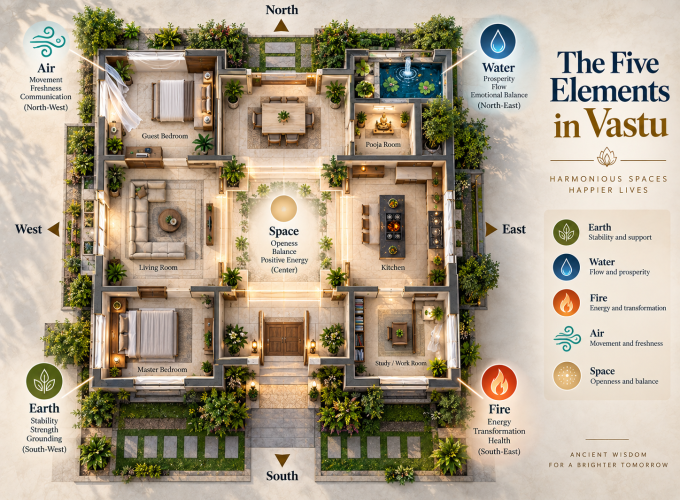
Another important connection is with the Pancha Mahabhutas, or five traditional elements:
Vastu Shastra seeks harmony among these elements through spatial planning.
For instance, water-related elements are given importance in certain zones, while the South-East is associated with the fire principle. Open space and airflow are also considered important aspects of a balanced environment.
The Mandala provides a structured way to think about these relationships rather than treating each recommendation as an isolated rule.
Yes, but its application needs to be understood in the context of modern life.
Today’s buildings are very different from traditional homes. Apartments, high-rise offices, compact urban homes, commercial complexes, and mixed-use buildings all have different limitations.
Instead of blindly following individual Vastu rules, the Vastu Purush Mandala can be viewed as a traditional planning philosophy that encourages balance, orientation, proportion, openness, and thoughtful use of space.
For many people, its value is not only spiritual. Some of its traditional planning ideas can also encourage practical considerations such as natural light, ventilation, organized movement, and avoiding unnecessary congestion.
The Vastu Purush Mandala is much more than a diagram divided into squares. It represents an ancient way of understanding the relationship between human spaces, directions, nature, and the larger cosmic order.
Its central idea is simple: a well-planned space should feel balanced rather than random.
Whether you are constructing a house, designing a villa, planning an office, or developing a commercial property, understanding the Mandala can provide useful insight into the traditional foundations of Vastu Shastra.
At the same time, Vastu principles should be integrated thoughtfully with modern architecture, structural safety, functionality, and the actual needs of the people using the space.
Good design is not just about where a room is placed. It is about creating a space that works beautifully, feels comfortable, and supports the way people live and work.
Ready to align your space for health, harmony, and growth?
© 2025-2026 Vaastublessings • All Rights Reserved. Designed by Esuccess Academy